
Wednesday, 18 August 2010

MANNERS MAKETH THE MAN
Good manners involve treating people with respect and courtesy, and making people feel comfortable in different situations.
Biblical rule- "do as you would be done by"
Cultural traditions
Religious beliefs
Social status
Economic class
Above are reasons for manners being different in different places. What might be seen as good manners in one country, might be grossly inappropriate in another.
People usually learn the manners which fit their lifestyle, and travellers need to learn the manners, so they fit into the country they are visiting.
People with good manners are likely to get ahead in the world of business, where good manners are remembered and may also diffuse tension, in certain situations.
TABLE MANNERS: in Europe
United Kingdom
Example: someone who has never eaten a formal dinner can still demonstrate good manners by following other people around the table.
Good manners involve treating people with respect and courtesy, and making people feel comfortable in different situations.
Biblical rule- "do as you would be done by"
Cultural traditions
Religious beliefs
Social status
Economic class
Above are reasons for manners being different in different places. What might be seen as good manners in one country, might be grossly inappropriate in another.
People usually learn the manners which fit their lifestyle, and travellers need to learn the manners, so they fit into the country they are visiting.
People with good manners are likely to get ahead in the world of business, where good manners are remembered and may also diffuse tension, in certain situations.
TABLE MANNERS: in Europe
United Kingdom
- If there are a number of knife and forks, work from the outside inwards, as each course is served.
- If resting whilst eating, fork should be at 8 o'clock on your plate and the knife at 4 o'clock, resting on the plate. Cutlery should never be placed back onto the table once it has been used.
- Food should be bought to the mouth on the back of the fork.
- Never lean across anyone else's plate.
- Must not put elbows on the table.
- Swallow all food before eating more or drinking.
- Dishes should be served from the left and taken away from the right.
- Drinks to the right of the plate, and side plate to the left.
- Fork should be held in the left hand and knife in the right.
France and Switzerland
- French bread is always torn off, not cut. Do not dip into sauce or soup.
- Must not put elbows on the table.
- Finish everything on plate before getting more.
- Always keep both hands on the table while eating, even if one hand is not in use.
Russia
- Do not talk with food in your mouth.
- No unpleasant noises.
- Small food should not be cut.
- It is polite to leave a bit of food at the end of the meal. To show the host that food and hospitality was appreciated. The host will often urge the guests for second helpings.
- Don't look into another's plate or saucer.
Table manners in Japan:
- Never place chopsticks vertically into a bowl of food. (traditional presentation for offering to one's ancestors)
- Wait until host/hostess tells you to eat three times before eating.
- Soup is eaten by holding bowl to the mouth, not with a spoon.
- It is acceptable to make slurping noises when eating hot noodles. Japanese believe that inhaling air when eating noodles improves the flavour. No noise should be made when eating soup.
- When resting whilst eating, chopsticks should be rested on the hashi-oki (chopstick rest) provided.
- Should not gesture with chopsticks.
- Never pass food from one chopstick to another. (technique used only in Japanese Buddhist rites, transferring cremated bones into an urn)
- There is no tipping in Japanese restaurants.
Example: someone who has never eaten a formal dinner can still demonstrate good manners by following other people around the table.
Tuesday, 17 August 2010
GOOD MANNERS
"Good manners are a set of behaviours which mark someone as a civilised and cultured member of a society. Manners are usually taught from a young age, with some receiving additional training in etiquette."
Tuesday, 10 August 2010
GOOD FOR YOU
Vitamins
5 a day
Vegetables
Fish
ASDA good for you range
Guiness
Water
Sleep
Exercise
Wine
Chocolate

WATER:
It has been found that drinking hot water improves blood circulation. Adding honey and lemon boosts body immunity too.
Hot water makes the digestive system work smoothly.. also, a glass of hot water in the morning before anything else retains good skin, also if conscious about weight /figure, it decreases fats from the body.
drink 3-5 pints of water a day.
if 4-5% less than recommended, mental and physical performances are affected by up to 20-30%
Water flushes out toxins in the body (if they accumulate, can cause aches and pains)
DIET:
(Cook books)
- What food is good for what?
ASDA's good for you range:
- Contains less than 3% fat and fewer calories than standard product
- Customer's watching calorie intake, so this range of food to make it easier for them
- Light, lighter or reduced fat items has at least 30% less fat in than the standard equivalent product.
ORGANIC
Why do people eating organically?
- Feeding kids no additives
- Way of life
- Concerns about pesticide residue, farming methods, animal welfare + environment
RESEARCH NEEDED TO COLLECT about people's health:
- on average, how long do you sleep through the night/week
- favourite food
- how much fruit/veg eaten through the week
- favourite fruit/veg
- how much do you drink a week (alcohol)
- do you take vitamins
Tuesday, 3 August 2010


Monday, 2 August 2010
J.D WETHERSPOON

Wetherspoon is a british pub chain founded by Tim Martin in 1979. The company owns over 700 pubs and looking to increase to 1000 by 2012.
Wetherspoon pubs offer low price drinks, food, long opening hours, cask ale and no music.
The reason for there being no music in the pubs is a social thing. You go to the pub to talk and meet new people, to socialise. The Lloyds bars are the only Wetherspoon pub to have music on.
The first Wetherspoon pub to open was 'Marler's Bar' at Colney Hatch Lane in London.
The name, 'Wetherspoon' comes from Tim Martin's teacher, who couldn't control the class.
Before the 'no smoking inside' policy, Wetherspoon introduced this before the health act 2006 and converted some pubs to completely non-smoking as early as May 2006.
Tim Martin- Founder and Chairman:
Born: 28th April 1955 in Northern Ireland.
Educated at 11 different schools in Northern Ireland and New Zealand.
Studied Law at Nottingham University.
In 2005, he was voted the 5th 'most influential person in the UK pub industry.'
He is married with 4 children.
FOOD
BREAKFAST:

MAIN MENU:
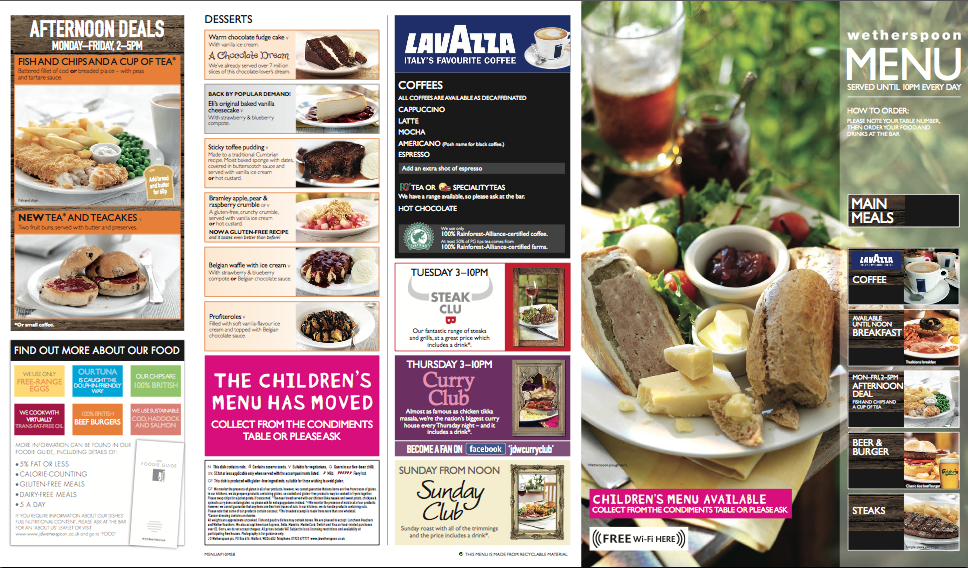

GLUTEN FREE:

KIDS MENU:

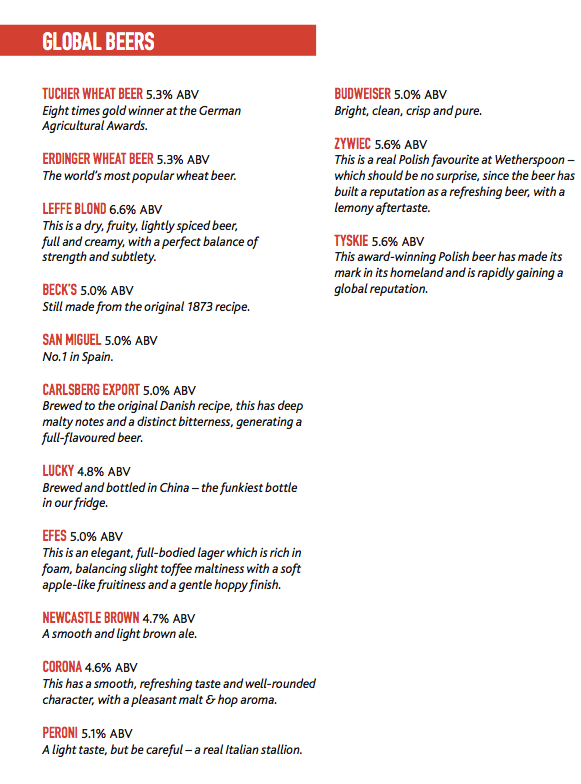
DRINK:


PROMOTIONS:
HOTELS:
Over the last 30 years, Wetherspoon has won literally hundred of national and regional awards. These awards acknowledge excellence in all aspects of business, from design, training, catering, safety and security, to responsible drinking, retailing and recycling.
Subscribe to:
Posts (Atom)